
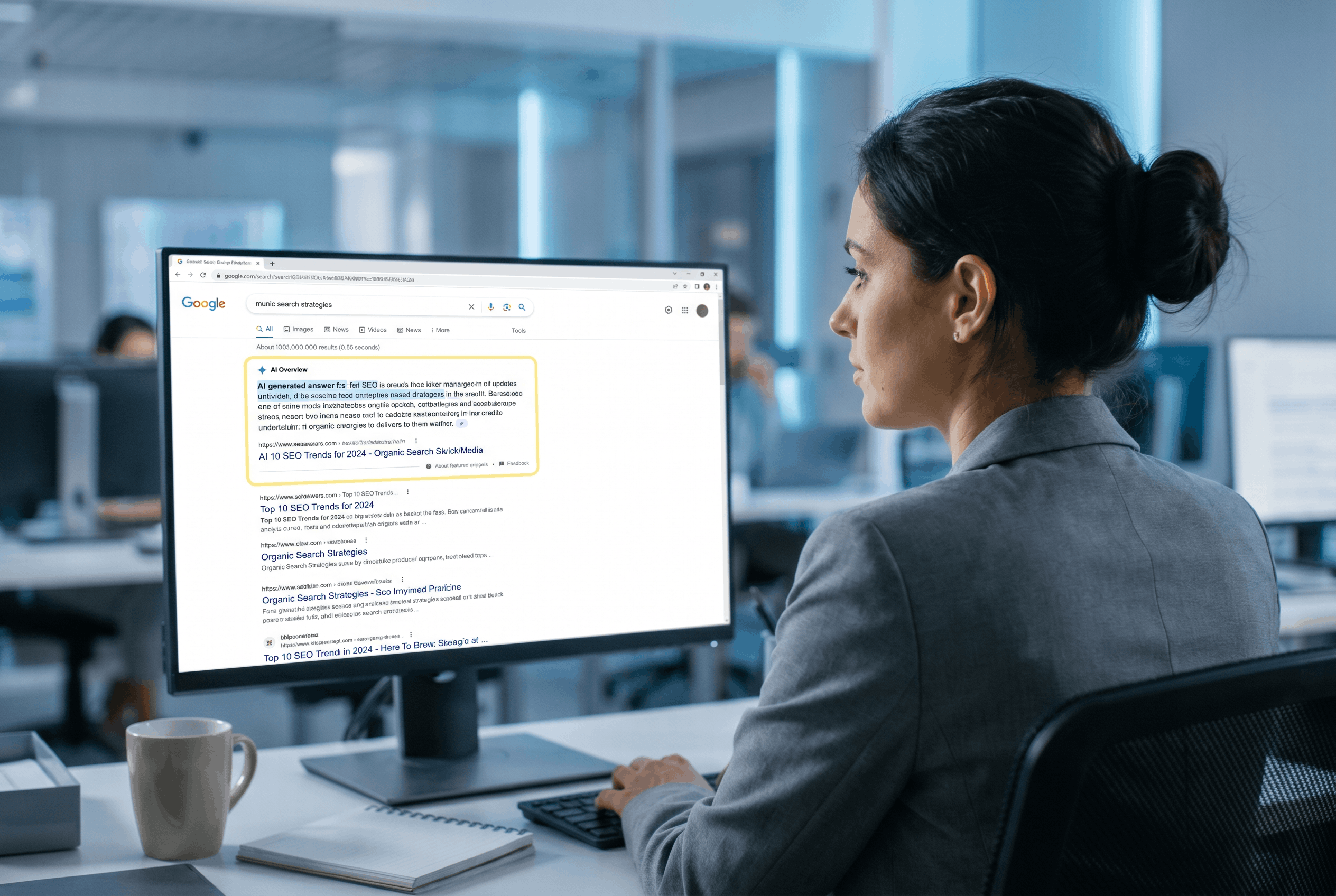
For years, the goal of SEO was simple: rank as high as possible on Google, and the traffic will follow. Page one was the promised land. Position one was the throne.
That model is breaking down — and fast.
AI Overviews, Google’s generative search feature that summarizes answers directly on the results page, have fundamentally changed what it means to rank well. According to Ahrefs research, the presence of an AI Overview correlates with a 34.5% lower click-through rate for the number one organic result across 300,000 informational keywords. [1] You can hold the top position and still lose a third of your expected traffic to a summary that appears above your result.
Separate research from Amsive, analyzing 700,000 keywords, found that traditional organic listings see an average 15.49% CTR drop when AI Overviews are present — with drops approaching 20% for non-branded queries and up to 37% when combined with featured snippets. [2]
This is the zero-click era. And it is reshaping the entire discovery funnel.
The implications for businesses that have built their digital strategy around traditional SEO are significant. Ranking for informational keywords — the kind that used to drive top-of-funnel traffic — is becoming less valuable as AI Overviews absorb those queries and answer them without sending users anywhere. The traffic that used to flow from “what is” and “how to” searches is increasingly staying on the Google results page.
So what do you do about it?
The answer emerging from the research community is Answer Engine Optimization, or AEO. Where traditional SEO optimizes content to rank in search results, AEO optimizes content to be cited and surfaced by AI systems. The goal is not just to appear on the page. It is to be the source that the AI draws from when it constructs its answer.
Research from Princeton, Georgia Tech, and IIT Delhi, published at ACM KDD 2024, introduced the framework of Generative Engine Optimization — the practice of structuring content so that AI systems are more likely to include it in generated responses. [3] The principles overlap significantly with AEO: clear, authoritative, well-structured content that directly answers specific questions tends to get cited more often than content optimized purely for keyword density.
What this means practically is that the content strategy that worked three years ago needs to evolve. Thin, keyword-stuffed pages that ranked on volume alone are losing ground. Deep, authoritative content that genuinely answers questions — and is structured in a way that AI can parse and cite — is gaining it.
It also means that brand visibility beyond Google is becoming more important. If AI systems are absorbing informational queries, businesses need to be present in the places where buyers go after the AI gives them an answer — review platforms, social proof, direct brand search, and channels where intent is already high.
The businesses that adapt to this shift early will maintain their visibility. The ones that keep optimizing for a search landscape that no longer exists will find their traffic quietly eroding, quarter by quarter, without a clear explanation for why.
Conversion Media Group helps businesses build digital strategies that account for where search is going — not just where it has been. If you want to stay visible in the AI search era, call us at 1-800-419-3201.
[1] Ahrefs, “AI Overviews Reduce Clicks”
[2] Search Engine Land, “Google AI Overviews Hurt Click-Through Rates”
[3] Digital Applied, “AI Overviews CTR Drops: Fight-Back Strategies”