
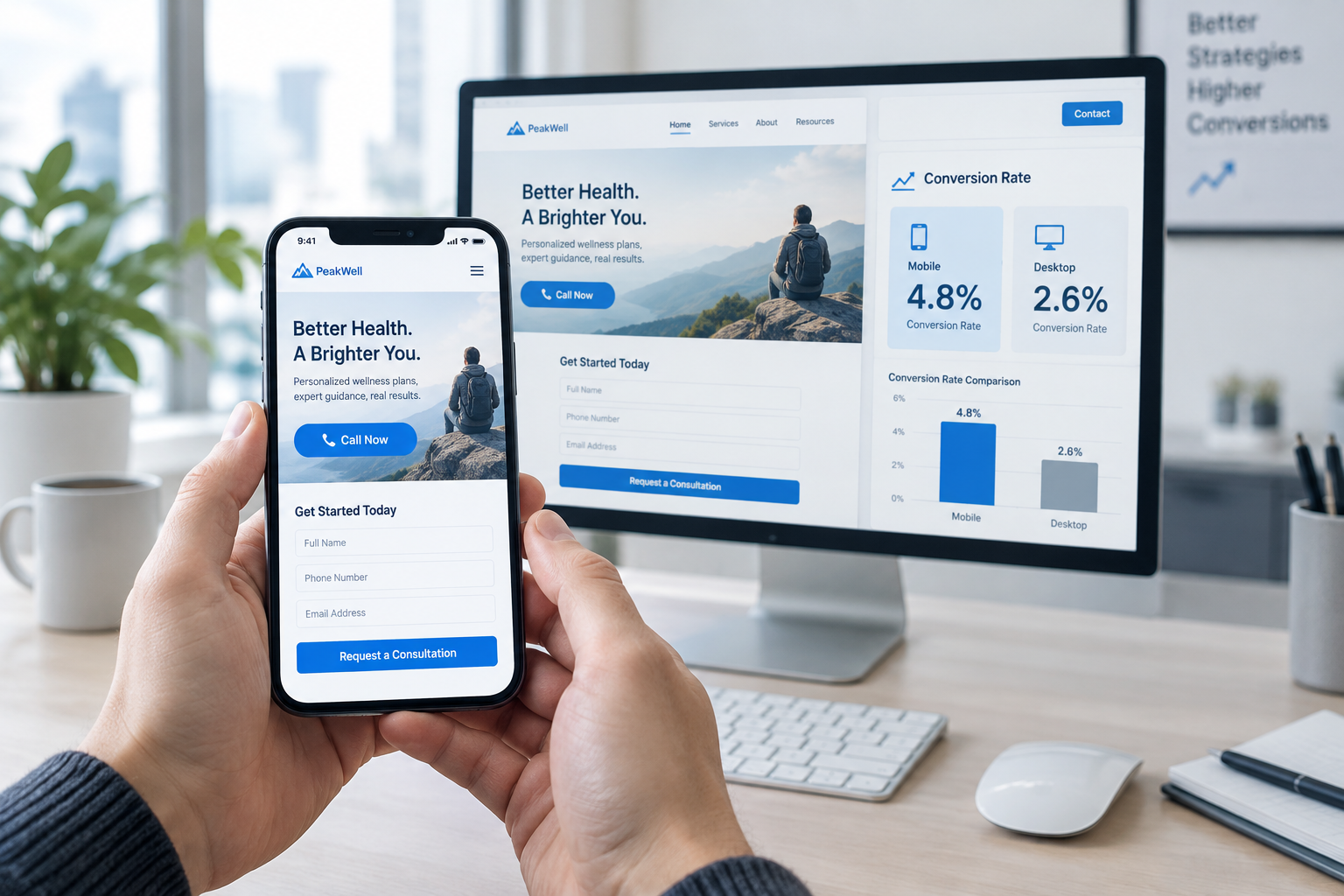
Most businesses know that mobile traffic has overtaken desktop traffic by a wide margin. What fewer businesses fully account for is that mobile traffic volume and mobile conversion performance are two very different things — and the gap between them has real implications for how a business should design its digital experience.
Recent benchmark data shows mobile traffic accounting for as much as 78% of total e-commerce traffic in some sectors, confirming that the majority of visitors arriving at most websites today are doing so from a phone. [1] But conversion rate data tells a different story: desktop conversion rates commonly outperform mobile conversion rates by a meaningful margin, with some benchmarks showing desktop converting at roughly 3.9% compared to mobile’s 2.85%, and other datasets showing desktop outperforming mobile by 12% or more depending on the specific vertical. [1]
This gap exists for understandable reasons. Mobile browsing often happens in shorter, more distracted sessions — someone scrolling during a commute, a break, or while doing something else simultaneously. Desktop sessions tend to represent more deliberate, focused engagement, often happening when someone has specifically sat down to research or make a decision. Smaller screens, touch-based input, and the friction of typing on a mobile keyboard also make complex forms and lengthy checkout processes meaningfully harder to complete on a phone than on a computer.
The strategic implication is not to deprioritize mobile — doing so would mean ignoring the majority of total traffic. It is to recognize that mobile and desktop experiences require different design priorities to perform well. A business cannot simply build a desktop-optimized experience and assume it will translate acceptably to mobile; the volume of mobile traffic means that even a modest conversion gap on mobile represents a very large absolute number of lost opportunities.
Practical priorities for closing this gap include fast mobile page load times, since mobile users are especially sensitive to any delay, simplified forms with as few required fields as possible, click-to-call buttons that let mobile users bypass typing entirely in favor of a phone call, and layouts specifically designed for thumb-based navigation rather than simply shrinking a desktop layout down to fit a smaller screen. [2]
For businesses in industries where phone calls convert particularly well — home services, healthcare, legal, education — mobile optimization that emphasizes click-to-call functionality over complex forms can meaningfully close the gap between mobile’s high traffic volume and its typically lower conversion performance, by routing mobile visitors toward the channel, a phone call, that plays to mobile’s actual strengths.
Conversion Media Group builds mobile-optimized consumer engagement strategies designed to convert the traffic that most businesses are currently underutilizing. Call us at 1-800-419-3201 to learn more.
[1] Semrush
[2] HubSpot