
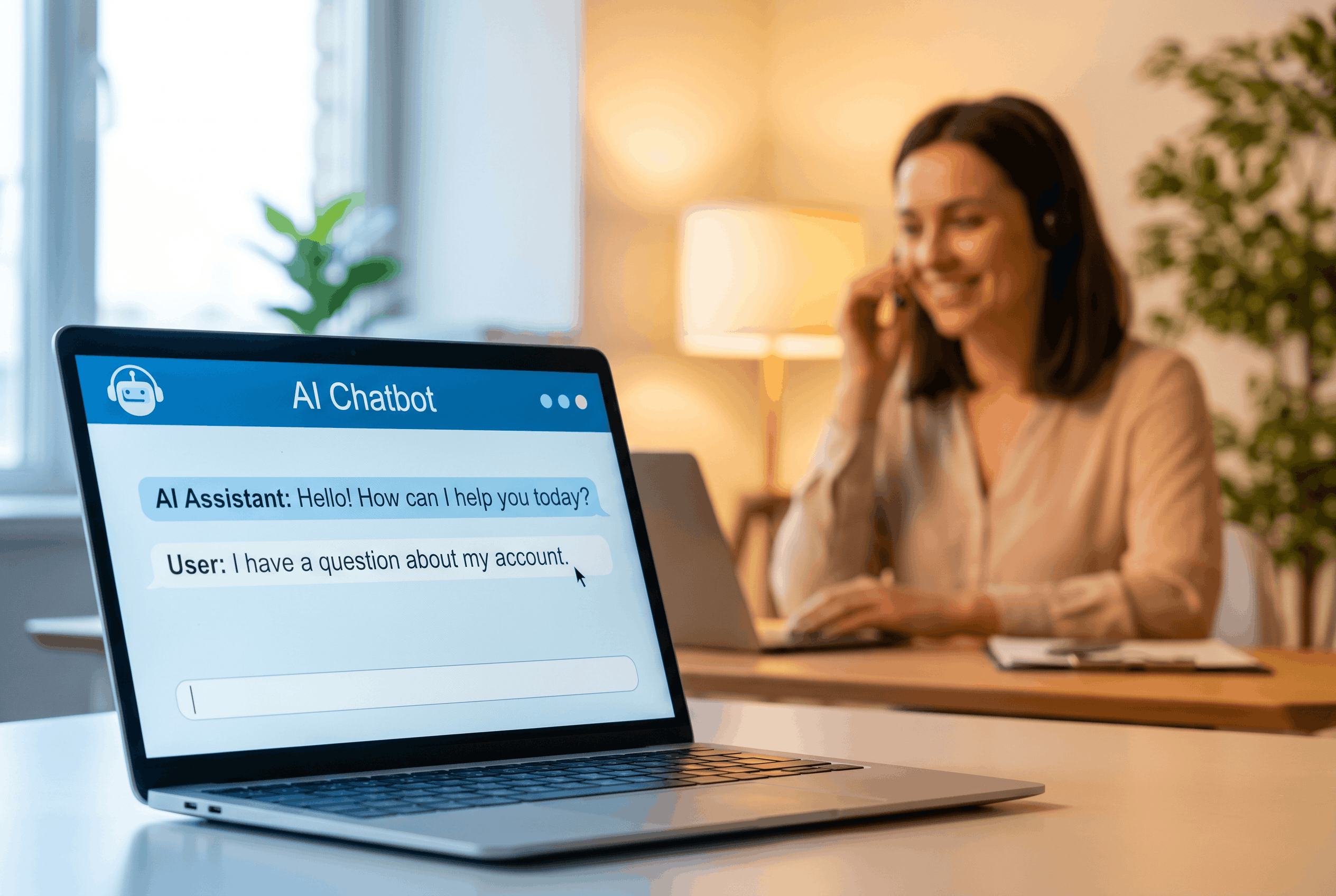
Before a prospect ever speaks to someone on your team, there is a good chance they have already had a conversation — with an AI.
Chatbots and AI-powered messaging tools have become a standard feature of the customer experience across industries. They handle initial inquiries, answer common questions, qualify interest, and in many cases, determine whether a prospect moves forward or moves on. And the businesses deploying them are doing so at scale, because the efficiency gains are real.
But there is a trust gap that most businesses are not accounting for — and it is costing them.
Research from Zendesk shows that while AI can handle a significant volume of customer interactions, 72% of consumers want to know when they are talking to AI rather than a human. [1] And 46% say they are more likely to engage with AI-assisted support if they know they can escalate to a human when needed. [1] The message from consumers is consistent: AI is acceptable, but only when it is transparent and when a human is available as a backup.
The businesses that are getting this right are not choosing between AI and human support. They are building hybrid models that use each for what it does best.
AI handles the high-volume, low-complexity interactions — answering FAQs, collecting basic information, routing inquiries to the right department, and providing immediate responses at any hour of the day. These are tasks where speed and availability matter more than nuance, and AI performs them reliably and at a fraction of the cost of human agents.
Human agents handle the conversations that actually require judgment — complex questions, emotionally sensitive situations, high-stakes decisions, and any interaction where a prospect needs to feel genuinely heard rather than efficiently processed. These are the conversations that determine whether a prospect becomes a customer, and they are not conversations you want to hand entirely to an algorithm.
The data from HubSpot’s customer service research reinforces this. Customers who can move seamlessly between AI and human support report significantly higher satisfaction than those stuck in either a fully automated or fully manual experience. [2] The hybrid model is not a compromise. It is the optimal design.
For businesses in education, healthcare, financial services, and professional services — industries where the stakes of each customer interaction are high — this distinction matters enormously. A prospect researching a nursing program or a financial planning service is not looking for a quick FAQ answer. They are making a significant decision and they need to feel that the business they are considering actually cares about getting it right.
Deploying AI without a clear human escalation path in those contexts does not just reduce satisfaction. It reduces conversion.
Conversion Media Group operates contact centers staffed by trained human specialists who handle the conversations that matter most — with AI supporting the process, not replacing the people. Call us at 1-800-419-3201 to talk about what a smarter customer engagement model looks like for your business.
[1] Zendesk, “AI Customer Service Statistics”