
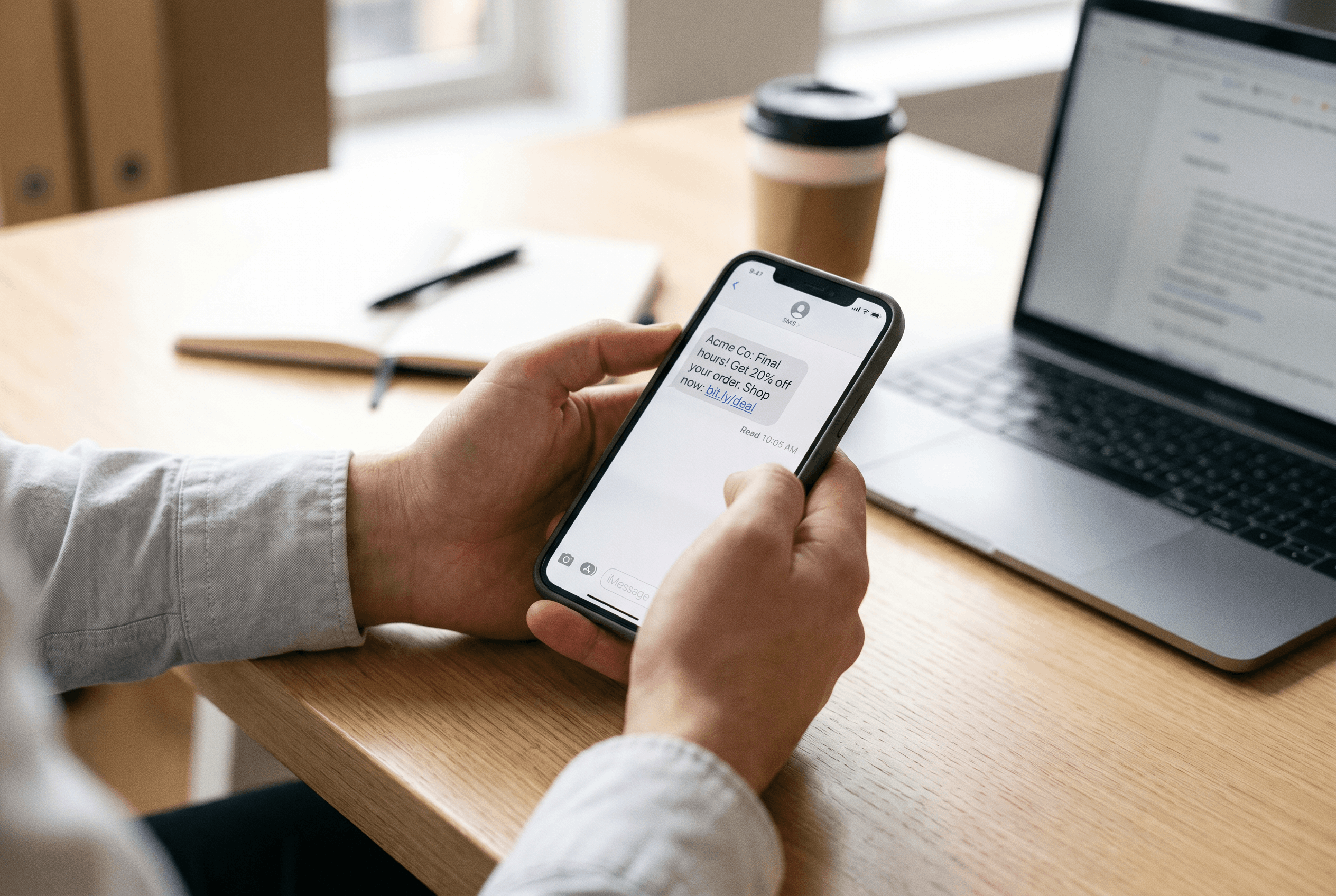
Every marketer knows the frustration of sending an email campaign and watching the open rate come back at 20%, maybe 25% on a good day. You craft the subject line, you segment the list, you test the send time — and still, the vast majority of your audience never even sees the message.
Now consider this: SMS messages have an open rate of approximately 98%. [1]
That is not a typo. Nearly every text message sent gets opened. And most of them get opened within minutes of delivery. [1] The gap between SMS and email is not a marginal difference in channel performance. It is a fundamental difference in how people relate to their inboxes versus their text messages.
And yet, for most businesses, SMS marketing remains an afterthought — or is not part of the strategy at all.
That is a significant missed opportunity, and the data makes it hard to justify.
The open rate advantage is only part of the story. SMS also outperforms email on response rate, with text messages generating response rates around 45% compared to roughly 6% for email. [2] When you combine those two numbers — near-universal opens and dramatically higher response rates — you get a channel that is, by most measurable standards, the highest-engagement marketing tool available to businesses right now.
The reason SMS performs so well comes down to behavior. People treat their text message inbox differently than their email inbox. Email has become a place where promotional content is expected, filtered, and often ignored. Text messages still carry a sense of immediacy and personal relevance. When a message arrives in that space, it gets attention.
But that dynamic is also what makes SMS marketing easy to get wrong. The same intimacy that makes the channel powerful makes it easy to abuse. Sending too frequently, messaging without clear opt-in consent, or delivering content that feels irrelevant will not just reduce engagement — it will generate opt-outs and damage the relationship with your audience in a way that is very difficult to recover from.
The businesses that are succeeding with SMS in 2025 and 2026 are treating it with the same strategic discipline they apply to their best-performing email programs. They are building opt-in lists carefully, segmenting by behavior and purchase history, personalizing messages based on what they actually know about each recipient, and keeping frequency low enough that every message feels like it belongs in that inbox.
Research from Omnisend confirms that personalized SMS campaigns — those using recipient name, recent activity, or purchase history — significantly outperform generic sends on both click-through and conversion. [3] The channel rewards relevance even more than email does, because the bar for what feels appropriate in a text message is higher.
If your business is not yet using SMS as part of its marketing mix, the case for starting is straightforward. The open rates are unmatched, the response rates are exceptional, and most of your competitors have not figured it out yet. That window will not stay open indefinitely.
Conversion Media Group helps businesses build multi-channel marketing strategies that reach audiences where they are most likely to respond. Call us at 1-800-419-3201 to talk about what a smarter outreach strategy looks like for your business.
[1] Omnisend, “SMS Marketing Statistics”